Everything you need to know about travelling to China 2025
Up-to-date 2025 guide to visas, entry rules, transport, money, connectivity, costs, safety, and family travel in China.
Everything you need to know about travelling to China in 2025
Planning a trip to China in 2025? Here’s our practical guide where we share all you actually need to know. From visas and land border entry to transport, payments, and family tips, this is everything we learned during our spontaneous three week China adventure in October 2025.
What surprised us in 2025 (on-the-ground notes)
- Everything was easier than we expected day-to-day. The people we met were friendly, helpful, and kind.
- Internet access was the main challenge. Mobile data with an eSIM worked far more reliably than many hotel WiFis (details below).
- Smoking in hotel rooms is real. We didn’t enjoy smokey rooms in a few locations. But most hotels will be willing to help you find a smoke-free room.
- We did not expect coffee costs to be closer to western prices, this could be important for your budget if you’re a daily coffee person like my husband.
Visas and Entry Requirements
- Check if you qualify for visa-free transit or short-stay exemptions based on your nationality and itinerary. As of December 2024, New Zealand and Australian citizens, and a few other nationalities qualify for 30 days visa free entry. Check for updated visa requirements when you travel. From what we understand, New Zealand and Australia have this visa exempt travel extended through 2026 with additional countries added to the list. For the official list of countries covered by unilateral visa exemption policies, see the National Immigration Administration website.
- Keep printed copies of hotel bookings, onward/return flights, and travel insurance. Most people probably won’t be asked, but during our entry we were asked about our travel plans (I’m totally blaming myself for wearing a t-shirt with a Bitcoin logo - don’t do this).
- If immigration officers ask for onward travel proof, Onward Ticket emails you a verified reservation in under a minute. This is a handy peace of mind without locking in a full fare.
- Be mindful of regional entry controls for certain areas that require additional permits (for example, Tibet). We kept our itinerary pretty simple, overland from Vietnam to China via the Lao Cai and Hekou land border and travelled by train from Hekou to Jianshui, to Kunming, to Chengdu, to Xi’an to Beijing. For detailed information about our overland route, see our Hoi An to Beijing overland rail journey guide.
Health and Travel Insurance
- Comprehensive travel insurance with medical coverage is always a good idea. We’ve travelled with WorldNomads, Genki and SafetyWing. It’s always important to thoroughly check policies to ensure you have the coverage you need for your travels.
- Major cities appear to have excellent hospitals. We walked through a hospital park in Chengdu, and it seemed like a beautiful place compared to other hospitals I’ve seen around the world. Fortunately, we didn’t have to visit in person this trip.
- Tap water is generally not potable. It’s recommended to use bottled, filtered or boiled water. We found most accommodations were happy to supply water for us.
Unfortunately, things can and do go wrong when you travel. World Nomads offers coverage for more than 150 activities as well as emergency medical, lost luggage, trip cancellation and more.
Disclosure: We receive a fee when you get a quote from World Nomads using this link. We do not represent World Nomads. This is not a recommendation to buy travel insurance.
Money, Payments, and ATMs
- Currency is the Chinese Yuan (RMB/CNY). ATMs are widely available in cities.
- Mobile payments (Alipay/WeChat Pay) are easy and widely used. We linked our digital Wise card to our WeChat and AliPay which made paying for everything effortless.
- In practice, Alipay was easier for us to get going quickly, but WeChat Pay worked well once we learned the in-app scan flow (by week 2 it felt seamless).
- Expect to pay via QR everywhere—even small street markets and roadside vendors.
- Make sure to remember to tell your bank about your travel. It’s always a good idea to have more than one or two cards for payment options. I lost access to two accounts during our China trip and having multiple accounts made this less of an issue than it would have been if I didn’t have access to other accounts and payment options.
Connectivity and SIM Cards
- Buy a Trip.com eSIM before you travel. I usually advise to buy a local sim, but in China, the local ones are useless because you won’t be able to use all your favourite apps. Everything from social media, to Gmail will be blocked if you choose a local sim card. Our eSIM from Trip.com worked excellently and became essential. My tip here is buy more data than usual, as you’ll likely be fully reliant on this sim data.
- Our backup is our Roamless eSIM. This worked fine while we were trying to navigate getting the trip.com eSIM running properly.
- Many apps and sites may require a VPN. Make sure you set this up before arrival if you rely on blocked services. While we were in China, we relied on Nord VPN and it worked great. Sometimes, we’d need to change the country we were connecting to, but for the most part, we were able to access everything we needed.
- Hotel and café WiFi is common but speed varies. Some WiFi networks allowed VPN connections, others cut access when a VPN was detected, and occasionally specific sites worked for a while with VPN, then later stopped.
- Relying on our eSIM avoided many restrictions, though we did notice occasional throttling on mobile data. I was always able to use apps and VPNs when I needed them. Trade-off: hotel WiFi could be faster but more restricted.
Handy Apps and Navigation
- Translations: Download offline packs in Google Translate. Note: Google Translate worked consistently with mobile data (eSIM), however, sometimes we had issues if we for whatever reason couldn’t use the eSIM. Have a backup translate app for times may need to rely on WiFi.
- Maps: We used AMaps and Google Maps. Expect inconsistency. We found that some places shown on Google were no longer operating, and AMaps reviews are often in Chinese, making it really hard to decide where to dine a lot of the time!
- Ride-hailing: DiDi is essential. The schedule feature is great to prebook rides the day before when you need a car at a specific time.
Tip: Don’t overcomplicate DiDi. Just pick your destination and book. You will be prompted to pay with AliPay when the ride is completed. It’s really easy (we got stuck thinking we needed to connect DiDi inside WeChat Pay -don’t bother, you don’t need this).
Getting Around: Transport
- High-speed rail connects most major cities and even regional areas. There are far more routes than Rome2Rio will show. I highly recommend using 12306.cn or Trip.com for train bookings. I recommend booking ahead for popular routes and if you have a family, book as soon as you can to help ensure you’re seated together. Our trip was spontaneous and we booked things quite last minute. This meant that some of our train bookings we could not all sit together.
- Domestic flights cover long distances efficiently. We didn’t use the domestic airports at all because we chose to do our entire trip via train. I do know you’ll need to allow additional time for security checks…
- On security checks, most people were losing their international power banks at airports. We got ours through at the train station in Hekou all the way to Chengdu. We left our powerbank behind when it stopped holding a charge, so I’m not sure it would’ve made it beyond Beijing airport.
- Urban transport: We didn’t use the metros, however, in the cities it appeared that they were clean, efficient, and signed in English. It was easy to find where the train lines went on AMaps. However, being a family of six and travelling as a group of nine, we mainly relied on taxis and ride-hailing which are widely available, and nice and easy with DiDi.
Trains: practical tips from our trip
- Book as early as you can for popular routes, especially when travelling as a family, if you would like to sit together. When we booked late, we were split across two coaches.
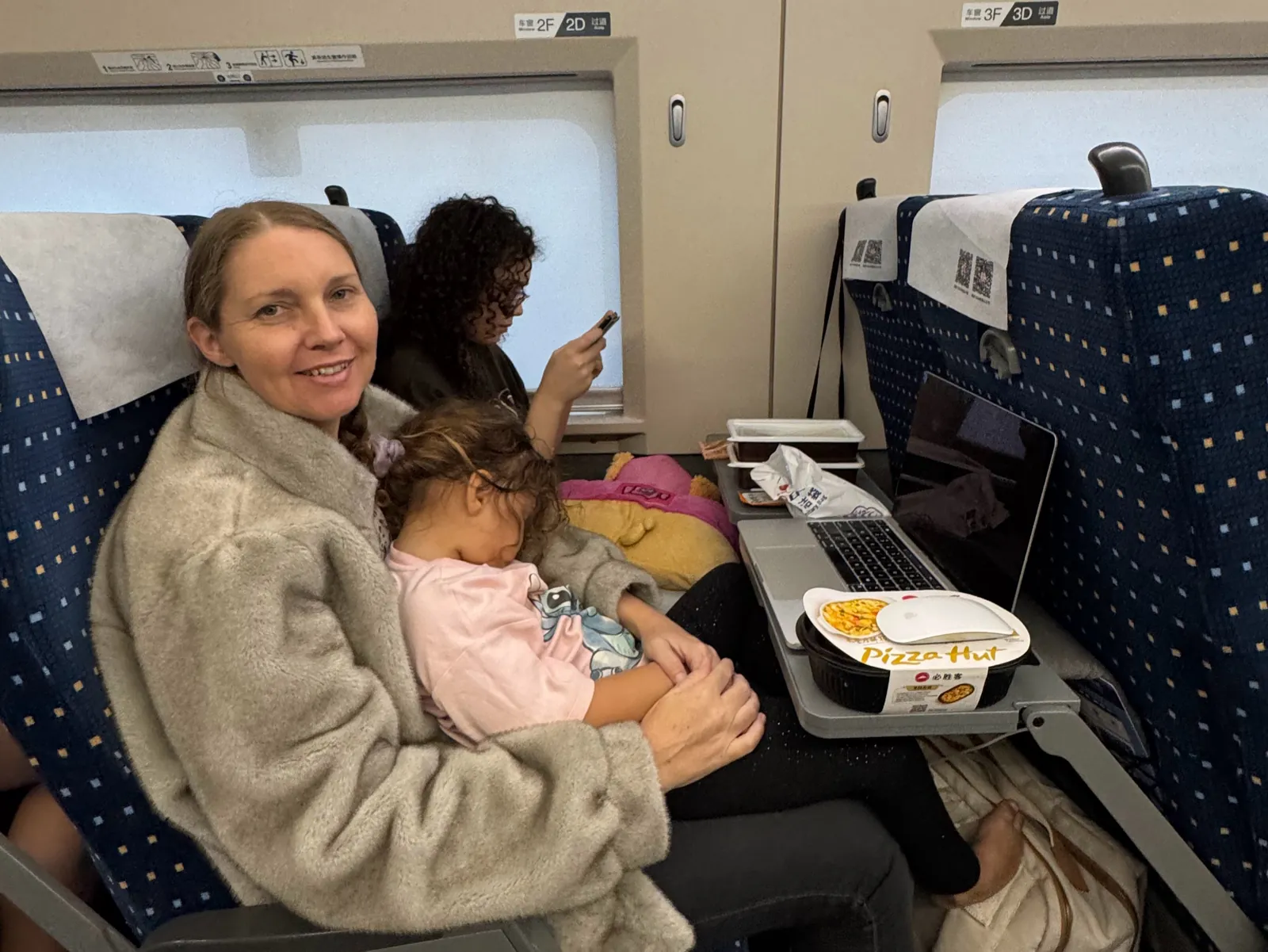
- If seats are occupied by mistake, train staff will help. When this happened to us, someone refused to move (2 out of 3 of our seats were occupied), however, other fellow passengers were accommodating and we ended up seated together after some shuffling.
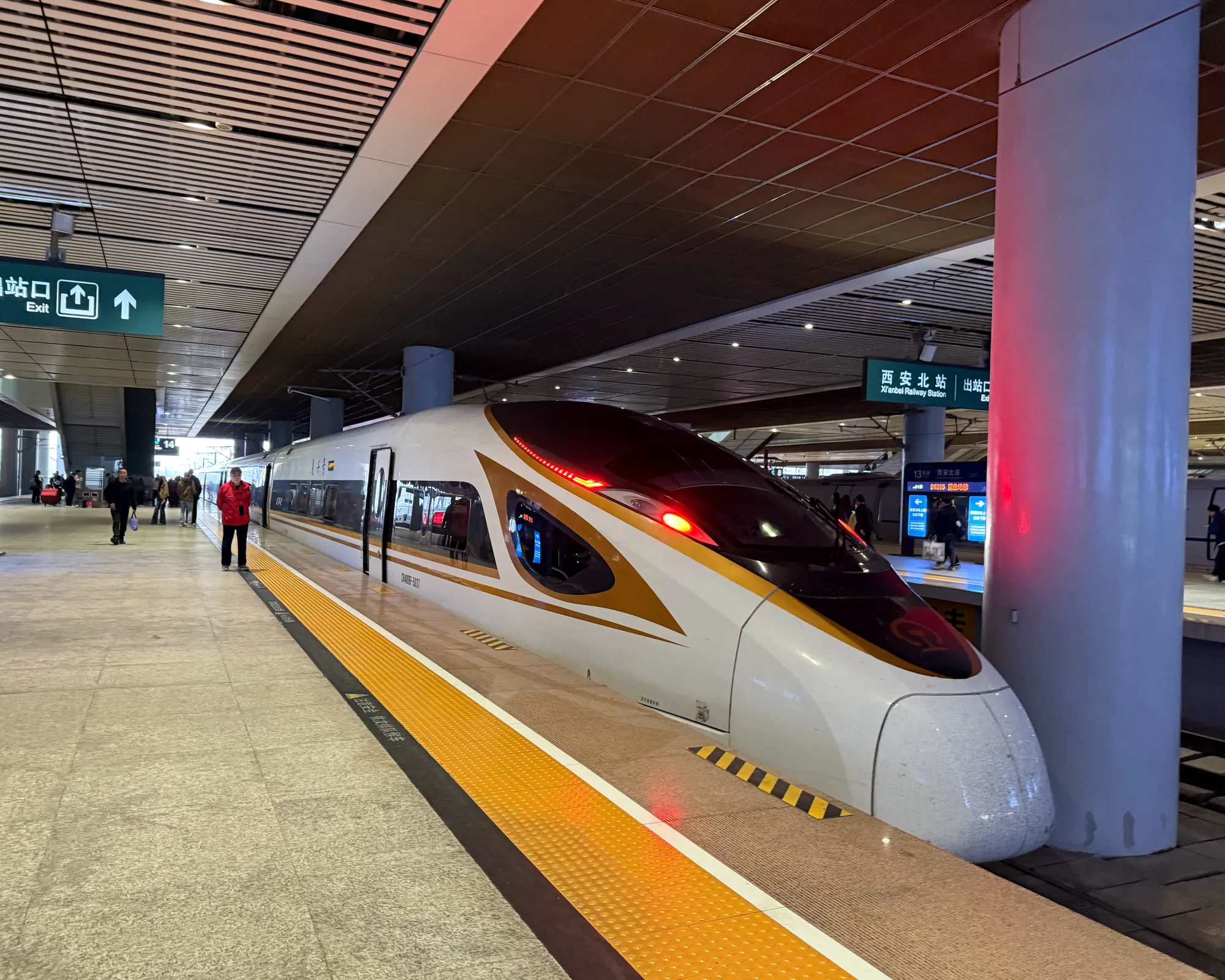
- Stations are efficient. You’ll need passports to enter through security and you must have prebooked tickets (e.g., 12306.cn or Trip.com). In the stations you can watch departure boards for gate and assembly area.
- For platform access, line up at a manual passport check lane with your passport ready. Arrive early for busy routes. On our Xi’an → Beijing leg we joined the line late and barely made boarding. This made it stressful as we were travelling as a large group. I was not in my daughters good books after running to the train with only a couple of minutes to spare.
Toilets in China: what to expect
- At the airport we found clean Western toilets.
- High-speed train stations generally have a mix of clean Western and squat toilets.
- Regional stations often only had squat options.
- Onboard trains: typically one Western and one squat toilet per coach area (e.g., Western at one end, squat at the other; or a pair at front/rear of the coach). We didn’t experience any train where we couldn’t find a Western toilet.
- In the smaller towns, Western toilets were harder to find.
- In the bigger, more touristic cities, we had no problem finding Western toilets near the tourist sites.
- As always, when in Asia, travel with a pack of tissues and some sanitizer and you’ll mostly be pretty ok. If you have children that want to be super clean, you can take sanitizing wipes.
Accommodation
- International chains and boutique hotels are common in major cities. Family rooms and apartments are available.
- There are usually a mix of both smoking and non-smoking rooms. If you discover a smokey smell in your room, in most cases you should be able to request another room. We found hotel staff very accommodating in the hotels we stayed in.
- Always carry your passport for hotel registration.
Safety and Etiquette
- China is generally very safe. As usual, watch for petty theft in crowded areas and big cities. We consistently found people friendly and willing to help and never felt unsafe. Also, you’ll notice cameras everywhere. I think, for the most part, it could be one of the safest countries to visit as a traveller - in the world.
- Be respectful at religious/historic sites. Make sure to follow rules which are usually displayed in English.
- Learn a few basic phrases. It’s helpful outside tourist centers. While I didn’t personally learn a lot, my Ni Hao gained many smiles and even some attempted conversations in Chinese. My husband on the other hand was chatting to taxi drivers in basic Mandarin by the third week.
- Carry your passport everywhere. This is one country you would not want to be without your passport if a police officer asked to see it. I did a Google search on this and felt it was a bit too scary to risk being without a passport anywhere. More scary than a fine.
Food and Dietary Notes
- Regional cuisines vary widely. We really enjoyed the Chinese burgers in Xi’an. We noticed that street food is popular. It’s always best to choose busy, clean vendors. This would be the same as eating street food anywhere in Asia.
- Vegetarian/vegan options exist but you may need to use clear communication.
- If you’re sensitive, carry allergy cards translated into Chinese (probably a good idea in most countries, really).
Regional favorites we loved
- Jianshui: traditional ceremonial tofu
- Chengdu: hotpot (mind the spice for kids!)
- Xi’an: “Chinese hamburgers” (roujiamo) and classic noodle dishes
- Beijing: We experienced a broad variety. Especially while staying out at Mutianyu near the Great Wall. We had access to an excellent chef who helped us try many different dishes. I couldn’t tell you a lot of what we ate, but I can tell you it was all good!

Family Travel Tips
- Metros are stroller-friendly; stations have elevators, though sometimes busy. If you’re taking metros and navigating the cities with a stroller, make sure you activate the Wheelchair-accessible walking navigation setting. It’ll help you find the most direct path with elevators.
- Pack snacks, tissues, and hand sanitizer (and sanitizing wipes if needed) for day trips.
- Many museums/parks have kid-friendly exhibits and open spaces.
- Many places offer strollers for hire. The only place we couldn’t get one was in Forbidden City, due to strollers already fully rented out.
Travelling with toddlers
- Stroller hire was available at major attractions we visited (e.g., Chengdu Panda Base, Terracotta Warriors). However, we found that Forbidden City rentals were scarce later in the day.
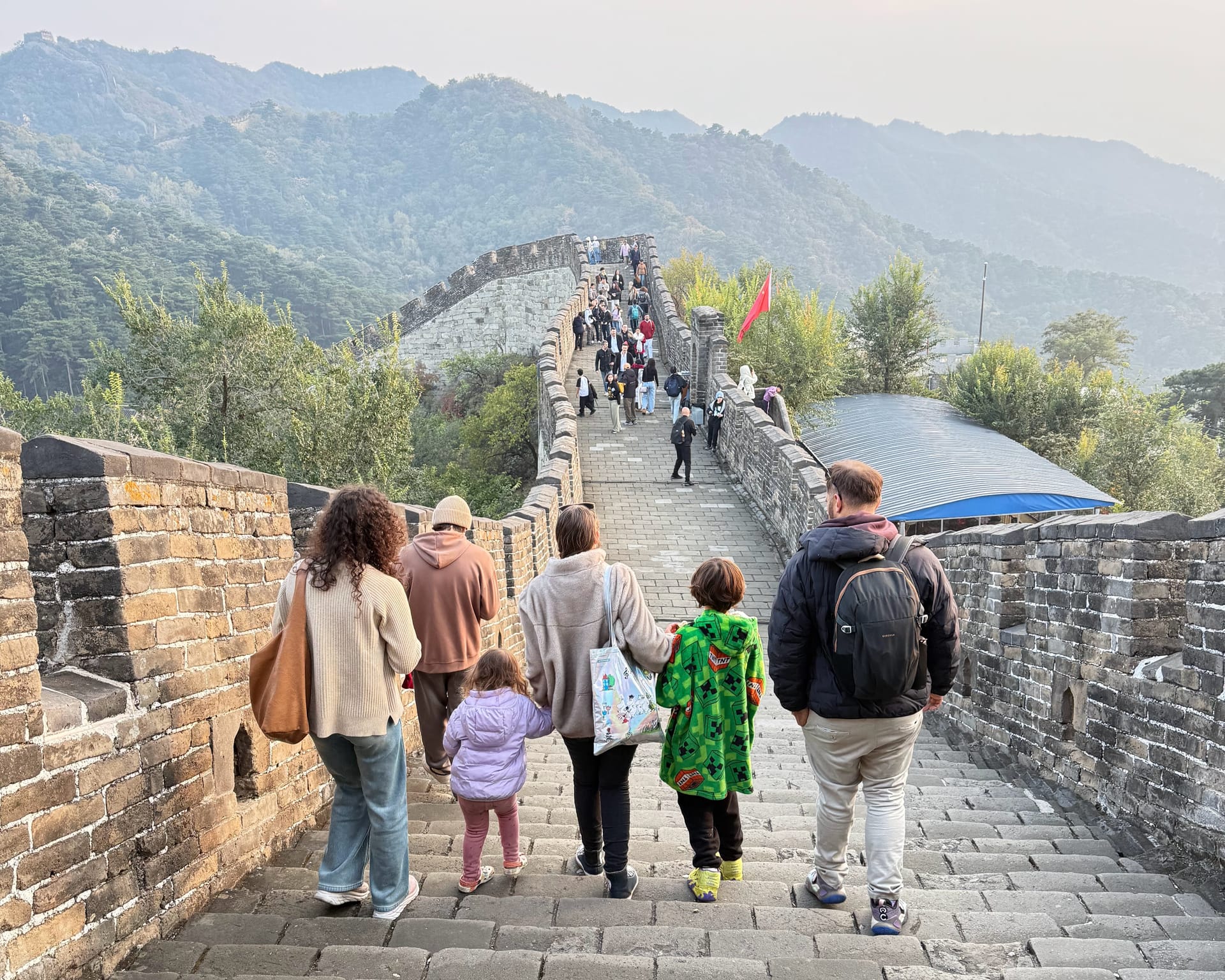
- Skip strollers for the Great Wall: steep stairs and narrow tower entries make it impractical. Plan snack breaks and let toddlers walk at their pace. There are plenty of places to sit down and rest between towers.
Budget Snapshot (per person, mid-range)
- Accommodation: $40–120 USD/night
- Meals: $10–30 USD/day
- Intercity transport: $20–120 USD (rail/flight)
- Attractions: $5–40 USD each
Packing Essentials
- Layers for seasonal changes: we didn’t realize quite how much the temperature and climate would vary. We experienced very warm temperatures down in the southern areas, and days later felt freezing cold for the final 10 days of our journey!
- Comfortable walking shoes are always good if you’re planning to explore over long days (important for Chengdu Panda Sanctuary and the Great Wall)
- Universal adapter: We almost got caught out. When checking for the plug sockets in China, we noticed a lot of recommendations for the European two pin plugs both round and flat. We wrongly assumed it would be similar to Vietnam and only took our two pin round plugs. In the first few places, we found there were only sockets for two flat pins or three pins like the ones in Australia and New Zealand.
- Portable power bank: Keep in mind that you may need to just buy (or hire) one in China. Many people lose their power banks at airport security checks.
- Copies of key documents (paper + digital)
- Reusable bottle (easy to find these in China if you need a new one); basic meds and sunscreen
Seasonal Notes
- Spring (Mar–May) and Autumn (Sep–Nov) are ideal.
- Summer can be hot and humid; winters in the north are cold. To be clear, we were on the Great Wall during the final week of October and it was close to freezing during the nights.
- Golden Week (first week of October) and major holidays are extremely busy. Personally, I would avoid these times, but if you need to go during high seasons, book well in advance.
FAQs
Do I need cash if I use mobile payments? Yes—carry backup cash for small vendors or connectivity issues. In saying this, we never experienced any issues paying with AliPay which seemed to be accepted by most everyone.
Is English widely spoken? In major cities and tourist areas you’ll find English signage; basic phrases help elsewhere.
Can I rely on trains for long distances? Yes! High-speed rail is fast and comfortable. Make sure you book early for peak times.
Are VPNs necessary? If you rely on certain international apps/sites, set up before arrival and comply with local laws.
Have questions about planning your China trip? Tell me your route and family needs. I’m happy to suggest a tailored itinerary.

About Melissa
A family passionate about slow travel and exploring the world with our four children. We share our experiences, tips, and insights to help other families create their own travel adventures.
You might also like



Aitutaki - The Fantasy Honeymoon Island
Discover Aitutaki, the fantasy honeymoon island in the Cook Islands. From overwater bungalows to lagoon cruises, explore this perfect romantic paradise.
Comments
Comments Coming Soon
We're working on adding a comments system to make it easier for you to share your thoughts and experiences.
In the meantime, feel free to reach out to us via our contact page or social media.
Stay Updated
Get the latest travel tips, destination guides, and family adventure stories delivered straight to your inbox.
No spam, unsubscribe at any time.